If you’ve ever stood in a combine harvester demonstration field, you’ve probably heard two terms bounced around like they’re new coinage: rotary combine and conventional combine. As someone who’s supplied agricultural equipment to small family farms and large commercial operations alike for over a decade, I get how confusing these terms can be—especially when every farmer I talk to swears by the machine that’s worked for their land for 20 years. Let’s break this down not just with specs, but with the real-world use cases that matter when you’re planting your equipment budget for next season. Combine Harvester
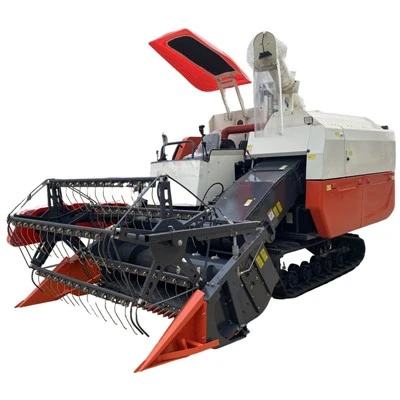
First, let’s ground this in what every combine does at its core: harvest grain by cutting it, separating the edible grain from the straw and chaff, and cleaning that grain so it’s ready for market or storage. The big difference between rotary and conventional combines lies entirely in that separation step—and how each machine handles the volume and type of crop moving through it.
Conventional combines, sometimes called “axial flow” by old heads in the game, have been around since the mid-20th century. Their separation system works like a series of flat, mesh pans (called concaves) that sit under a rotating threshing cylinder. The cylinder spins fast, knocking heads of grain against the concaves to break the kernels loose, and then the grain falls through the mesh while the straw moves along over the top of the pans, eventually being ejected out the back of the machine. It’s a straightforward system—you’ve probably seen one at a county fair demo, loud, a bit clunky, and built to last through years of steady use.
Rotary combines are the newer kid on the block, hitting the market in the 1970s, and they reimagined that separation step completely. Instead of flat pans, they use a long, enclosed, rotating cylinder (called a rotor) that spins at a slower speed than a conventional threshing cylinder. The rotor pushes the entire crop—grain, straw, all—through a curved, spiral path inside the machine. That constant, gentle (relative to conventional) turning motion rubs the grain loose from the heads and separates it from the chaff without slamming it around as hard. Think of it like rinsing dirt off veggies in a spinning colander instead of rubbing them on a rough board.
Let’s get specific about the differences that actually matter to you, the farmer, not just engineers in a lab. First up: grain damage. This is a huge one because damaged grain sells for 10 to 20 percent less at the elevator, and it’s way more likely to spoil during storage. Conventional cylinders spin anywhere from 600 to 1,200 RPM, slamming grain against metal concaves with force that can crack or break kernels—especially soft grains like oats or barley. I’ve had a customer come to me last year with 120 acres of malting barley that got damaged so bad with his old conventional combine, he lost $1,800 on the harvest. Rotary rotors, on the other hand, spin at 200 to 400 RPM, so the separation is gentler. That same malting barley he tried with his conventional? He swapped to a rotary and only had 0.8 percent damage, well under the 2 percent threshold maltsters require.
Next, throughput—how much acreage you can harvest in an hour. For large corn or wheat operations, this is non-negotiable. Conventional combines are great for light, dry crops like small grains, but when you’re going through dense, wet corn or heavy canola, their flat pan system gets backed up fast. The straw clogs the concaves, and you have to stop every 10 acres to clear a jam, which wastes hours. Rotary combines handle 20 to 30 percent more volume per hour because the enclosed spiral doesn’t clog as easily. I worked with a 2,000-acre corn farm in Iowa last harvest; last season they used a conventional combine and got 18 acres per hour. This year they tried a rotary, and they hit 24 acres per hour. That extra 6 acres per hour meant they finished their harvest three days earlier, avoiding a late September rainstorm that would’ve sprouted corn kernels right on the stalk.
But throughput isn’t all upside—especially if you’re farming hilly or sloped land. Conventional combines have a lower center of gravity because their threshing system is shorter and closer to the ground. If you’re working fields that aren’t perfectly flat, that stability matters. I had a customer in western Kentucky who farms on rolling terrain; he bought a rotary combine a few years ago for the throughput he saw his neighbor get, but he spent half the harvest season repairing the machine when it tipped on a steep hill. Conventional combines are heavier down low, so they grip the ground better on slopes, even when loaded with wet, heavy crop. That’s a detail a lot of sales reps gloss over, but it’s make-or-break for small-scale or hilly operations.
Then there’s crop flexibility. If you only grow one crop year after year—say, soft red winter wheat—both machines will work for you. But if you rotate between wheat, corn, soybeans, and canola, rotary combines win here too. The adjustable spiral speed and concave clearance on most modern rotary models mean you can switch between crops in 15 minutes or less. A conventional combine, on the other hand, needs a full hour to change concaves and adjust cylinder speed for different grain types, which adds up if you’re moving between 100-acre fields of different crops. Last month I had a customer who farms 500 acres, rotating corn and soybeans; he used to take two full days to switch between crops on his conventional. Now with a rotary, he does it in an hour, cutting down on downtime between harvests.
Wait, let’s talk about maintenance, because that’s a big hidden cost. Conventional combines have moving parts that are easier to get to—threshing cylinder, concaves, cleaning shoe—so if something breaks, a local mechanic can fix it in an afternoon, no special tools. Rotaries have enclosed rotors and more complex hydraulic systems to adjust the spiral path, so repairs often take longer, and you might have to wait for a specialized tech to drive out to your farm. I’ve seen a small operation with 100 acres of soybeans skip buying a rotary because their local mechanic charges $50 an hour more for rotary repairs vs. conventional. Also, concaves on conventional combines wear out faster than the spiral paths on rotaries, so you’ll replace those every 500 to 700 acres, whereas a rotary’s rotor only needs servicing every 1,500 acres.
Let’s not forget fuel efficiency. This is where the lines blur a little, but generally, rotary combines use less fuel per acre. Because they process more volume in less time, the engine doesn’t have to work as hard to move that crop through. In my experience, a rotary uses about 0.7 gallons of fuel per acre, while a conventional uses 0.9 to 1.1 gallons per acre. For a 1,000-acre corn harvest, that’s 200 extra gallons of fuel saved—at $3.50 a gallon, that’s $700 back in your pocket. I had a customer in Kansas who tracked his fuel use last year: 800 acres of wheat, conventional combine, $880 in fuel. Switched to a rotary this year, same acreage, $620 in fuel. That’s enough to cover a full set of replacement tires for the combine.
Now, let’s clear up a myth that’s been around since rotaries first came out: rotaries don’t work for small farms. I’ve supplied rotary models for farms as small as 200 acres, and they work great—if you do a lot of crop rotation. But if you’re a small family farm growing one crop, a conventional is still the better bet because it’s cheaper upfront, easier to maintain, and works just as well. The key is matching the machine to your specific operation, not the neighbor’s fancy new model.
Let’s sum this up, plain and simple, no engineering jargon: If you farm large, flat, high-volume fields with multiple crops and want to cut harvest time, reduce grain damage, and save on fuel, go rotary. If you farm small, hilly, or single-crop fields where stability and low repair costs matter more, a conventional combine is your better choice.
At the end of the day, I’ve seen customers make the wrong call by listening to hype instead of their own farm’s needs—losing money on damaged grain, wasting time on repairs, or paying for capacity they don’t need. I’m here to help you figure out which one fits your operation, not push the most expensive model on the lot. If you’re planning for next harvest, whether you’re replacing an old combine or upgrading for a larger acreage, don’t guess. Reach out to discuss your specific farm needs, and I’ll walk you through our models that fit both small and large operations, no pressure, no fine print.
Farm Tractor Attachments References
- American Society of Agricultural and Biological Engineers. (2021). Combine Harvester Threshing and Separation Systems. ASABE Standard S343.
- USDA Agricultural Research Service. (2019). Harvest Efficiency and Grain Damage in Small Grains: Rotary vs. Conventional Combine Performance. ARS Technical Report 10-19.
- Farm Equipment Manufacturers Association. (2022). Combine Harvester Market Trends: Operator Preferences and Application-Specific Needs. FEMA Annual Equipment Survey.
Huzhou Liangyi Agro Machinery Co., Ltd.
As one of the most professional combine harvester manufacturers and suppliers in China, we have world-leading production equipment and strong manufacturing capabilities. Please rest assured to wholesale advanced combine harvester from our factory. Contact us for more cheap products.
Address: High-Tech Industrial Zone, Huzhou City, Zhejiang Province, China
E-mail: Liangyi_agro@126.Com
WebSite: https://www.cnliangyi-agro.com/
